Shop on Lazada
Closeup products
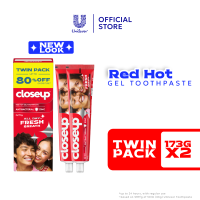
Closeup Gel Toothpaste with Antibacterial Zinc Red Hot 173g Twin Pack
₱180.19₱284.00
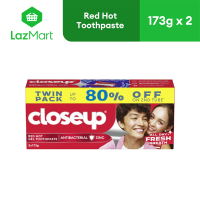
Closeup Red Hot Toothpaste Twinpack 173g x 2
₱152.00₱172.00
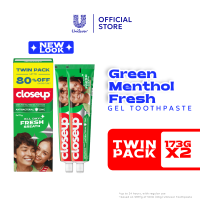
Closeup Gel Toothpaste with Antibacterial Zinc Menthol Fresh 173g Twin Pack
₱180.19₱284.00
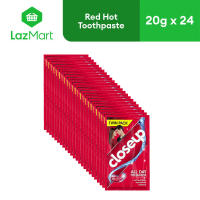
Closeup Red Hot Toothpaste 10g x 2 - Pack of 24
₱189.00₱215.00
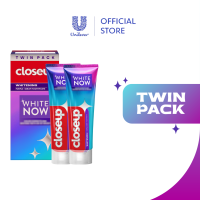
Closeup White Now Toothpaste Purple Serum Gel 2x 100G
₱191.00₱304.00
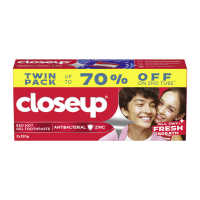
Closeup Red Hot Twin Pack 120g x 2
₱131.00₱148.00
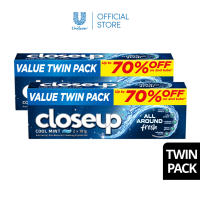
Closeup All Around Fresh Gel Toothpaste Cool Mint 191g Bundle of 4
₱567.00
Buy on Lazada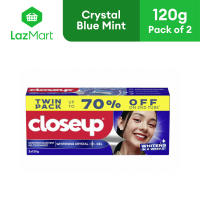
Closeup Whitening Crystal Blue Mint Promo Twin Pack 120G x 2
₱130.00₱147.50
About Closeup
Closeup (also styled Close-Up or Close Up) is an international oral-care brand best known for its gel toothpaste, particularly products positioned around fresh breath, whitening, antibacterial protection, and confidence in social interactions. The brand is part of Unilever’s personal-care portfolio in most markets and is sold across numerous countries, including Indonesia, India, the Philippines, Nigeria, Brazil, Bangladesh, Sri Lanka, Peru, and Argentina.1
In the Philippines, Closeup is primarily recognized as a youth-oriented toothpaste brand that emphasizes freshness and social confidence alongside standard oral hygiene benefits. While specific local variants evolve frequently, the Philippine market typically features products aligned with the brand’s global focus on intense freshness and whitening.614
Basic information
| Category | Information |
|---|---|
| Brand | Closeup / Close-Up |
| Industry | Oral care / personal care |
| Main products | Toothpaste and, in some markets, mouthwash |
| Parent company | Unilever, outside North America |
| Origin | United States |
| Introduced | 1960s |
| Signature format | Transparent/colored gel toothpaste |
| Core positioning | Fresh breath, clean/whiter teeth, confidence |
| Major markets | Asia, Africa, Latin America and other international markets |
| Philippine market | Closeup toothpaste and oral-care products |
| Current brand idea | Confidence to get closer |
Ownership
Closeup is associated globally with Unilever, although its ownership and licensing structure differs in North America. The brand was licensed to Church & Dwight for the U.S. market, while Unilever operates the brand in the rest of the world, including the Philippines.2
History
Origins
Closeup’s history dates back to the 1960s. According to the brand’s corporate history, its story began in 1965 when it introduced a fundamentally different kind of toothpaste: a transparent gel formulation incorporating mouthwash-related freshness technology.3
At the time, conventional toothpaste was largely associated with opaque, white, chalk-based formulations. Closeup differentiated itself through its colored or transparent gel appearance, strong flavors, and emphasis on freshness. This distinction was central to the brand’s identity; rather than being marketed solely as a cleaning agent, Closeup was presented as a product that could make people feel fresh and confident enough to interact more closely with others.
There is a minor discrepancy in published dates regarding its launch. Some secondary references cite 1967 as the commercial introduction date, while Closeup’s own corporate history states that its story began in 1965.4
The gel toothpaste concept
The gel format became one of Closeup’s defining characteristics. The brand describes its technology as combining a silica-based formulation with mouthwash-inspired ingredients in a transparent gel. These formulations are designed to provide long-lasting freshness while supporting conventional oral-health benefits such as fluoride-based cavity protection and stain or plaque removal.5
This innovation helped distinguish Closeup from traditional white toothpaste brands. Key elements of its visual and sensory identity include:
- Transparent or brightly colored gel
- Strong mint and other flavors
- Cooling sensation
- Emphasis on freshness
- Youthful packaging
- Association with social confidence
Consequently, Closeup became more than a functional toothpaste brand. “Fresh breath” became the central emotional benefit around which much of its marketing was built.
Brand positioning
Closeup has historically occupied a distinct position compared to traditional family-oriented cavity-protection toothpastes. Its central proposition links fresh breath to confidence and the willingness to get closer to people. The modern brand expresses this through the idea “Confidence to get closer,” connecting oral freshness and whiter teeth with the confidence required for interpersonal relationships.6
This positioning explains why Closeup advertising frequently revolves around dating, romance, friendships, social interaction, first impressions, and young people. In essence, Closeup sells an emotional outcome as much as an oral-care benefit.
Target audience
Closeup has traditionally maintained a strong youth-oriented positioning. Rather than presenting toothpaste primarily as a family health product, its advertising has often portrayed brushing as preparation for social situations—meeting someone, going on a date, talking closely with another person, or simply feeling confident in public.
This makes its target audience particularly associated with young adults, socially active consumers, appearance-conscious individuals, people concerned about bad breath, and consumers seeking freshness and whitening. The brand’s purpose has increasingly broadened beyond romance; Unilever describes Closeup as a brand intended to encourage people to overcome self-consciousness and feel confident enough to connect with others.7
Products
Closeup’s portfolio varies substantially between countries, and there is no single identical global product range. In the Philippines, product availability is adapted to local preferences and market trends.8
Toothpaste
The core category is gel toothpaste. Depending on the market, Closeup sells products emphasizing fresh breath, antibacterial protection, whitening, plaque removal, cavity protection, cooling sensations, herbal ingredients, and multi-benefit oral care.
While specific Philippine SKUs change over time, the brand’s global and regional portfolios illustrate the types of variants available in similar markets:
- Menthol Fresh: Marketed in various Asian markets as a green menthol gel toothpaste emphasizing long-lasting fresh breath. Formulations typically include zinc sulfate and sodium fluoride.9
- Icy White: Focuses on a cooling sensation, cleaning, plaque reduction, and making teeth appear naturally whiter. Ingredients often include hydrated silica, sodium fluoride, and menthol.10
- White Now: A family oriented toward visibly whiter teeth, including variants like Purple Stain Corrector and Kaolin Mineral Whitener in select markets.
- Korea Everfresh: Available in flavors such as Spearmint and Eucalyptus, featuring fluoride and a strong freshness proposition inspired by Korean beauty trends.11
- Multivitamin Complete Fresh Protection: Positioned around broader oral-care benefits through vitamins, minerals, and antibacterial technology.17
Consumers in the Philippines should consult local retail listings or the official Philippine website for the current assortment, as formulations and names are localized.
Technology
Closeup’s technology narrative centers on the combination of gel toothpaste and freshness. According to the brand, its formulations combine silica-based gel technology, fluoride for cavity protection, zinc or antibacterial ingredients in relevant variants, flavoring and cooling agents, and whitening components where applicable.5
The brand states that its gel format can enhance fluoride availability and provide a freshness experience comparable in concept to mouthwash.6 It is important to note that not every Closeup toothpaste contains the same ingredients or provides identical benefits; claims are specific to individual product variants.
Marketing and advertising
Marketing is one of Closeup’s most distinctive characteristics. While traditional toothpaste advertising often follows a linear path of “brush teeth → prevent cavities → maintain oral health,” Closeup adds an emotional layer: “brush teeth → fresh breath → confidence → get closer.”
This approach has produced advertising centered heavily on human relationships. The brand’s contemporary purpose is explicitly connected to closeness and the freedom to love, with Unilever describing Closeup as a catalyst for bringing people closer together.12 This strategy is effective because bad breath is both an oral-care problem and a source of social anxiety. Closeup therefore transforms an everyday hygiene concern into an emotional narrative about confidence.
Brand personality
Closeup’s personality can be broadly described through several key attributes:
| Attribute | Closeup’s positioning |
|---|---|
| Young | Youth-oriented communication |
| Energetic | Strong flavors, colors and freshness |
| Social | Focus on interpersonal interaction |
| Confident | Encourages consumers to overcome self-consciousness |
| Playful | Often uses romance and humor |
| Modern | Gel format and contemporary packaging |
| Sensual | Historically associated with physical closeness |
| Inclusive | Modern purpose emphasizes different forms of closeness |
The central psychological territory for the brand is confidence achieved through freshness.
Global presence
Closeup is an international brand rather than one confined to a single national market. Official materials identify markets including Indonesia, the Philippines, India, Sri Lanka, Iran, Brazil, Russia, Bangladesh, Peru, and Argentina, while Unilever’s corporate materials document particularly strong market positions in countries such as Nigeria.13
Product names and formulas differ considerably between countries to suit local tastes. For example, the UK portfolio has included Menthol Paradise and Red Hot; India features Triple Fresh Formula products; Indonesia offers Korea Everfresh; and Nigeria has historically featured Red Hot and Cool Breeze.14 This localization allows Closeup to adapt flavors, pack sizes, formulations, and marketing to individual markets like the Philippines while maintaining a consistent global identity.
Relationship with Unilever
Closeup belongs to the broader Unilever personal-care and oral-care ecosystem. It exists alongside other major oral-care brands, including Pepsodent, although the brands generally occupy different marketing territories. Closeup is particularly associated with freshness, confidence, and social closeness rather than exclusively clinical oral-health protection.
Unilever has also categorized Closeup among its Sustainable Living Brands, reflecting the company’s purpose-driven brand strategy.18
Brand purpose
Closeup’s stated purpose extends beyond toothpaste functionality. The brand argues that people can become reluctant to get close to others due to concerns about bad breath or their smile. Closeup attempts to remove this psychological barrier by helping people feel sufficiently fresh and confident to connect with others.
Unilever’s corporate materials describe Closeup’s mission as celebrating different forms of closeness and expressing the belief that people should be free to love.18 This makes Closeup a notable example of purpose-led FMCG branding, where a relatively ordinary product is connected to a larger human motivation.
Competitive landscape
Closeup operates in the highly competitive oral-care industry. Depending on the country, major competitors can include Colgate, Pepsodent, Signal, Sensodyne, Oral-B, Aquafresh, and Darlie.
Closeup’s differentiation lies not necessarily in providing a unique oral-health function, but in the combination of its gel format, intense freshness, youthful identity, social confidence, and relationship-oriented advertising. This positioning allows it to compete on both functional and emotional benefits.
Distinctive characteristics
From a branding perspective, Closeup is notable for five primary reasons:
Popularizing gel toothpaste
The brand’s origin story is strongly tied to being an early pioneer of transparent gel toothpaste in the 1960s.15
Making fresh breath a lifestyle proposition
Fresh breath is presented not merely as evidence of good hygiene, but as a prerequisite for confidence and social interaction.
Owning the idea of getting closer
The name Closeup itself lends naturally to a social and romantic positioning. The brand has built its communications around this linguistic association for decades.
Targeting emotion as well as hygiene
While many competitors focus heavily on dental health, Closeup frequently addresses the question of how confident a consumer feels when someone gets close to them.
Global adaptation
Although the core identity remains consistent, flavors, products, campaigns, and packaging are adapted to individual markets to ensure local relevance.15
Name and symbolism
The name “Closeup” has a functional relationship with the brand’s marketing. A “close-up” implies seeing something from very near, while “close” describes physical and emotional proximity. This creates a natural semantic bridge linking the brand name to intimacy, confidence, and fresh breath. The modern slogan, “Confidence to get closer,” makes this connection explicit.6
Legacy
After decades in the market, Closeup’s most significant legacy is arguably its brand territory. It helped establish the idea that oral-care products could be marketed through social confidence and personal relationships, rather than exclusively through dentists, cavities, and clinical health.
Its evolution can be understood as a progression from an innovative transparent gel toothpaste in the 1960s, to a symbol of freshness and distinctive gel identity in the late 20th century, to a focus on youth, dating, and social confidence in the 1990s and 2000s. In recent years, the brand has incorporated digital relationship marketing, broader oral care benefits, inclusivity, and purpose-driven messaging, culminating in its current positioning of “Confidence to get closer.”16
References
- Fresh Breath Technology | Closeup | Close up
- Produk Pasta Gigi | Closeup | Close up
- Semua Produk | Closeup | Close up
- Close-Up (toothpaste)
- Teknologi Pasta Gigi Gel Anti-Bakteri Close-Up: Nafas Segar & Gigi Putih | Closeup | Close up
- Our technology | Closeup | Close up
- Closeup for fresh breath & whiter teeth | Closeup | Close up
- Closeup Oral Care Products: Toothpaste & Mouthwash for Fresh Breath & Whiter Teeth | Closeup India | Close up
- Pasta Gigi Untuk Bau Mulut Closeup Menthol Fresh | Close up
- Pasta Gigi Penghilang Plak Closeup Icy White | Close up
- Closeup Everfresh Gel Toothpastes | Closeup | Close up
- Offre d’emploi pour le poste UI – Senior R&D Associate chez Unilever
- 549300MKFYEKVRWML317-2025-12-31-T01
- Personal Care Philippines Activation Research & Development Lead at Unilever
- Nuestra Historia | Closeup
- Pasta Gigi Gel | Closeup | Close up
- Pasta Gigi Closeup Multivitamin Complete Fresh Protection | Close up
- Closeup: Discover more about this innovative, inclusive brand. | Unilever | 16 comments