Shop on Lazada
BFGoodrich products
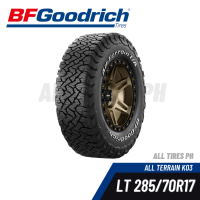
BFGoodrich LT 285/70 R17 KO3 - ALL TERRAIN T/A Tire (White Sidewall) S1
₱15,363.90₱19,800.00
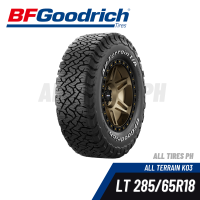
BFGoodrich LT 285/65 R18 KO3 - ALL TERRAIN T/A Tire (White Sidewall) S1
₱19,156.50₱23,800.00
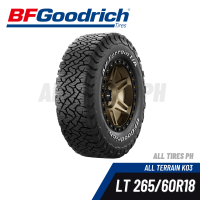
BFGoodrich LT 265/60 R18 KO3 - ALL TERRAIN T/A Tire S1
₱14,980.00₱18,800.00
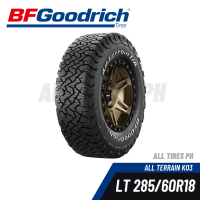
BFGoodrich LT 285/60 R18 KO3 - ALL TERRAIN T/A Tire (White Sidewall) S1
₱17,800.00₱23,800.00
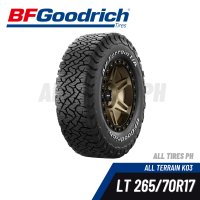
BFGoodrich LT 265/70 R17 KO3 - ALL TERRAIN T/A Tire S1
₱15,286.50₱19,800.00
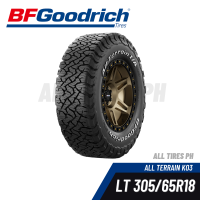
BFGoodrich LT 305/65 R18 KO3 - ALL TERRAIN T/A Tire (White Sidewall) S1
₱24,000.00₱25,800.00
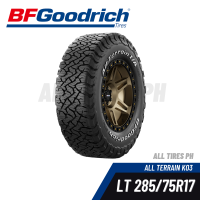
BFGoodrich LT 285/75 R17 KO3 - ALL TERRAIN T/A Tire (White Sidewall) S1
₱21,000.00₱22,800.00

BF Goodrich Tire 235/85 R16 All Terrain T/A K02
₱15,720.00
Buy on LazadaAbout BFGoodrich
Overview
BFGoodrich is an American tire brand with roots dating to 1870 in Akron, Ohio. Today, BFGoodrich is owned by Michelin and is best known for performance-oriented tires, particularly all-terrain, off-road, SUV, pickup-truck, and motorsport applications. Its identity is strongly associated with durability, traction, adventure, and racing-derived technology. 1
Basic Information
| Category | Information |
|---|---|
| Brand name | BFGoodrich |
| Founded | 1870 |
| Founder | Dr. Benjamin Franklin Goodrich |
| Origin | Akron, Ohio, United States |
| Original company | B.F. Goodrich Company |
| Industry | Tires / automotive |
| Current owner | Michelin |
| Main products | Passenger-car, SUV, pickup, all-terrain, mud-terrain, performance and racing tires |
| Core image | Performance, toughness, off-road capability and adventure |
| Major motorsport association | Baja, desert racing, rally/raid and other off-road competition |
| Current market | International / global |
BFGoodrich’s own history traces the brand to the establishment of a tire factory in Akron in 1870, while historical references identify BFGoodrich as an American tire brand that ultimately became part of Michelin’s portfolio. 2
1870: The Beginning
BFGoodrich’s story begins with Benjamin Franklin Goodrich, who established a rubber manufacturing business in Akron, Ohio, in 1870. Akron subsequently became one of the major centers of the American rubber and tire industry.
The company initially produced rubber products before moving into tires as the automobile industry began developing. BFGoodrich’s early involvement in tire technology helped establish the company as an important American tire manufacturer. 3
One particularly important development was the establishment of an early tire research facility by Charles Cross Goodrich, Benjamin Goodrich’s son. This helped reinforce the company’s emphasis on engineering and testing rather than simply manufacturing rubber products. 4
Early Automotive History
BFGoodrich became involved with automobiles during the formative years of the automotive industry.
One of the brand’s most famous historical milestones occurred in 1903, when a vehicle equipped with BFGoodrich tires completed the first documented automobile crossing of the United States from coast to coast. The vehicle was a Winton touring car, associated with Horatio Nelson Jackson’s pioneering journey. 5
This was important for the brand because it demonstrated a recurring theme that would later become central to BFGoodrich’s identity: the tire should be capable of taking the vehicle beyond ordinary roads. That philosophy eventually became particularly important in BFGoodrich’s off-road business.
Aviation and Aerospace Heritage
BFGoodrich’s history isn’t limited to automobiles. During the early 20th century, the company also entered the rapidly developing aviation industry. BFGoodrich tires were associated with several important aviation achievements. For example, the company participated in the 1909 international air race at Reims, where a Curtiss aircraft achieved a speed record of 75 km/h.
Perhaps the most famous connection came in 1927, when Charles Lindbergh’s Spirit of St. Louis used BFGoodrich tires during his historic solo nonstop transatlantic flight. 6
BFGoodrich later supplied tires for the Space Shuttle Columbia, another example of the company’s historical involvement in specialized transportation technology. 7
Motorsport Heritage
Motorsport is arguably the most important part of BFGoodrich’s modern brand identity. BFGoodrich began building a significant racing reputation in the early 20th century. In 1914 and 1915, it became the first tire manufacturer to win the Indianapolis 500 in consecutive years.
However, the company’s most distinctive motorsport identity eventually developed away from traditional circuit racing. BFGoodrich became particularly famous for Baja desert racing, where tires are exposed to rocks, sand, mud, heat, impacts and extremely long distances. This environment became an important real-world laboratory for BFGoodrich tire development. The company states that experience from on- and off-road racing has been applied to its production tires. 8
BFGoodrich subsequently developed a particularly strong reputation among:
- 4×4 enthusiasts
- Pickup owners
- SUV owners
- Overlanders
- Desert racers
- Off-road competitors
- Recreational trail drivers
Technological Milestones
BFGoodrich has a long history of tire-development milestones. Some notable examples include:
| Year | Milestone |
|---|---|
| 1870 | Benjamin Franklin Goodrich establishes the company in Akron |
| 1903 | BFGoodrich tires used on the vehicle that crossed the United States |
| 1914–1915 | Consecutive Indianapolis 500 victories |
| 1927 | Spirit of St. Louis uses BFGoodrich tires |
| 1947 | First tubeless tire for American cars |
| 1965 | First radial tire in the U.S. market, according to BFGoodrich’s historical account |
| 1967 | First run-flat tire |
| 1976 | Introduction of the world’s first all-terrain tire |
| 1981 | BFGoodrich tires fitted to Space Shuttle Columbia |
| 1983 | First Baja victory listed in BFGoodrich’s heritage timeline |
| 1995 | Introduction of a DOT-approved drag radial tire |
These milestones illustrate how BFGoodrich’s development moved from conventional road tires toward increasingly specialized performance and off-road products.
The All-Terrain Concept
One of BFGoodrich’s most influential contributions to the tire market is its development of the All-Terrain concept. In 1976, BFGoodrich introduced what it describes as the world’s first all-terrain tire. 9
The basic idea was relatively revolutionary: instead of designing a tire exclusively for highway driving or exclusively for extreme off-road use, create one capable of doing both. This concept eventually became one of BFGoodrich’s defining characteristics. The result is a tire category aimed at drivers who may use their vehicle on highways, gravel, dirt, mud, rocks, and trails without changing tires every time the surface changes.
Ownership Structure
The corporate history of BFGoodrich is somewhat complicated because BFGoodrich the tire brand and Goodrich Corporation, the broader industrial company, are not the same thing today.
The tire business was separated from the broader Goodrich industrial organization. Michelin acquired the relevant B.F. Goodrich and Uniroyal tire businesses around 1989–1990, bringing BFGoodrich into Michelin’s portfolio.
The broader Goodrich Corporation subsequently moved away from tires and became primarily an aerospace/industrial company before eventually being acquired by United Technologies in 2012. Therefore, the modern relationship can be summarized as: Benjamin Franklin Goodrich → B.F. Goodrich Company → Goodrich tire business → Michelin → modern BFGoodrich tire brand.
BFGoodrich therefore remains an American-origin brand, but it is now part of the French Michelin Group.
Brand Identity
Today, BFGoodrich positions itself as a tire brand “for enthusiasts, by enthusiasts.” Its official brand positioning emphasizes grip, control, performance and driving enjoyment, both on-road and off-road.
The brand’s personality can roughly be summarized as:
- Performance: Emphasizes handling, traction and control rather than simply transportation.
- Toughness: Off-road products are designed around resistance to impacts, punctures, abrasion and difficult terrain.
- Adventure: Marketing strongly associates the brand with exploration and driving beyond conventional roads.
- Motorsport: Racing is used not merely as advertising but as part of the brand’s engineering heritage.
- American heritage: Although owned by Michelin, BFGoodrich retains a distinctly American historical identity originating in Akron, Ohio.
Product Categories
BFGoodrich’s current lineup varies by country, but broadly covers several major categories.
All-Terrain
This is probably BFGoodrich’s most recognizable product category. The All-Terrain T/A family is aimed at vehicles that need a combination of highway usability and off-road capability. The current flagship example is the BFGoodrich All-Terrain T/A KO3, which replaced the highly successful KO2 in the newer generation. BFGoodrich describes the KO3 as an all-terrain tire designed for CUVs, SUVs and pickups, with severe-snow certification in applicable sizes/markets.
Features include updated tread design, all-terrain tread compound, full-depth 3D sipes, reinforced sidewall protection, optimized footprint, serrated shoulder design, mud-phobic bars, off-road traction features, and three-peak mountain snowflake (3PMSF) rating in applicable configurations.
Mud-Terrain
BFGoodrich also produces Mud-Terrain T/A tires for more aggressive off-road applications. The range is intended for drivers who prioritize traction in environments such as mud, rocks, loose dirt, deep trails, and difficult terrain. Examples include the Mud-Terrain T/A KM2 and KM3. 10
Compared with an All-Terrain tire, a Mud-Terrain tire generally sacrifices some highway refinement in exchange for more aggressive off-road capability.
Trail-Terrain
The Trail-Terrain T/A occupies a more road-oriented position. It is aimed at SUV and crossover drivers who spend most of their time on pavement but still want light off-road capability, gravel-road performance, all-season traction, durability, and longer-distance touring ability.
Highway / Everyday Tires
BFGoodrich also sells more conventional road tires, including the Advantage Touring family. These are designed for drivers whose priorities are focused on everyday road driving, handling, braking, comfort, tread life, and wet-weather performance.
Performance Tires
BFGoodrich also has a performance-oriented heritage through its g-Force products and racing-derived technology. These products target drivers interested in stronger grip and handling on paved roads.
The KO2 Phenomenon
No introduction to BFGoodrich would really be complete without mentioning the All-Terrain T/A KO2. The KO2 became one of the most recognizable all-terrain tires in the world and helped make BFGoodrich almost synonymous with aggressive-looking all-terrain tires.
Its popularity came from its combination of rugged appearance, off-road ability, highway usability, strong sidewalls, and extensive vehicle fitment. The tire became particularly popular on vehicles such as the Toyota Hilux, Toyota Tacoma, Toyota Land Cruiser, Ford Ranger, Ford F-Series, Chevrolet Silverado, Jeep Wrangler, Jeep Gladiator, Ram pickups, various SUVs, and expedition/overlanding vehicles.
The newer KO3 represents the next generation of this product family. BFGoodrich says the KO3 was engineered for greater durability and longevity while retaining the all-terrain concept.
Presence in the Philippines
BFGoodrich maintains a presence in the Philippines, offering its range of tires to local consumers. The brand’s focus on durability and off-road capability aligns well with the region’s diverse driving conditions, ranging from urban highways to rural and rough terrain. 12
While specific local production details for the Philippines are not highlighted in the primary global history, the brand operates within the broader Asian market framework, catering to the demand for robust tires suitable for trucks, SUVs, and 4×4 vehicles common in the archipelago.
Why BFGoodrich is Popular Among Enthusiasts
There are thousands of tire brands and models available worldwide, but BFGoodrich has achieved a particularly strong cultural position among off-road enthusiasts. There are several reasons:
- Long racing history: Decades of experience in desert and off-road competition.
- Real-world development: Learning from difficult racing environments and transferring that knowledge to consumer tires.
- Distinctive design: Aggressive tread and sidewall appearance, visually popular on modified trucks and SUVs.
- Product breadth: Offers everything from everyday SUV tires to extremely aggressive Mud-Terrain products.
- Brand credibility: Historical achievements, motorsport pedigree, and Michelin ownership provide considerable recognition.
Motorsport Identity
BFGoodrich has competed in and supported numerous forms of motorsport. Its strongest association is with off-road racing, especially:
- Baja 500
- Baja 1000
- Desert racing
- Rally raid
- Dakar
- Cross-country rally
BFGoodrich’s own historical material highlights victories in Baja and Dakar as major parts of its identity. The brand also notes its experience in events ranging from the deserts of Baja to the 24 Hours of Le Mans. 13
Motorsport functions as a technology-development platform as well as marketing. A simplified BFGoodrich development philosophy is: Race → learn → engineer → test → consumer tire.
Brand Positioning vs. Michelin
Although BFGoodrich is owned by Michelin, the two brands have noticeably different identities.
Michelin generally has a broader image covering passenger cars, premium vehicles, touring, performance, motorsport, commercial vehicles, motorcycles, aviation, and other mobility applications.
BFGoodrich, by comparison, has a much more focused personality: rugged, adventurous, American, off-road, pickup/SUV, motorsport, and performance-oriented. In other words, Michelin owns BFGoodrich, but it has preserved BFGoodrich as a distinct brand rather than simply turning every BFGoodrich product into a Michelin product.
Major Strengths
- Exceptional heritage: More than 150 years of history gives BFGoodrich considerable credibility.
- Strong off-road reputation: Few mainstream tire brands have such a strong association with 4×4 and desert racing.
- Motorsport-derived engineering: Strong connection between racing and consumer products.
- Strong product identity: KO2/KO3 and KM-series products have created recognizable product families.
- Global distribution: Sold across numerous international markets through Michelin’s global network.
- Strong visual identity: Aggressive tire designs and large sidewall lettering are closely associated with modified trucks and SUVs.
Potential Trade-offs
BFGoodrich tires are not automatically the best choice for every driver. For example, an aggressive All-Terrain or Mud-Terrain tire can involve trade-offs compared with a highway-focused tire:
- More road noise
- Potentially greater rolling resistance
- Different wet-road characteristics
- Potentially higher cost
- Heavier construction
- Different ride characteristics
- Reduced efficiency compared with a road-focused tire
The appropriate BFGoodrich product depends heavily on the vehicle and intended use. A person who drives almost exclusively on highways does not necessarily need the same tire as someone who regularly drives through mud, gravel, and rocky trails.
Naming Convention: What Does “T/A” Mean?
Names such as All-Terrain T/A KO3, Mud-Terrain T/A KM3, and Trail-Terrain T/A are frequently seen. The T/A designation is part of BFGoodrich’s established tire naming system and is strongly associated with its performance-oriented tire families.
The suffixes distinguish different generations and intended applications:
- KO → All-Terrain family
- KM → Mud-Terrain family
Exact specifications and available sizes vary by market.
Modern Brand Philosophy
BFGoodrich currently describes itself as a brand “for enthusiasts, by enthusiasts.” Its stated focus is giving drivers more control and grip and helping them enjoy driving both on and off the road. That gives the modern brand a very clear philosophy: Performance → Control → Capability → Adventure. Rather than presenting the tire merely as a maintenance component, BFGoodrich treats it as an important part of the vehicle’s ability to explore.
Legacy Timeline
- 1870: Benjamin Franklin Goodrich establishes the company in Akron, Ohio.
- Early 1900s: BFGoodrich enters the developing automobile and aviation industries.
- 1903: BFGoodrich-equipped vehicle completes the first coast-to-coast automobile crossing of the United States.
- 1914–1915: Back-to-back Indianapolis 500 victories.
- 1927: BFGoodrich tires are used on Charles Lindbergh’s Spirit of St. Louis.
- 1947: Tubeless tire milestone.
- 1960s: Major developments in radial and run-flat tire technology.
- 1976: Introduction of the All-Terrain tire concept.
- 1980s onward: Strong expansion of Baja and off-road racing involvement.
- 1989–1990: BFGoodrich’s tire business becomes part of Michelin through the acquisition of the Uniroyal/B.F. Goodrich tire operations.
- 1990s–2000s: Expansion of performance, off-road and commercial tire products.
- 2010s: KO2 becomes a major global all-terrain product.
- 2019: BFGoodrich All-Terrain T/A KO2 production begins at Laem Chabang, Thailand.
- 2020s: KO3 becomes the next generation of BFGoodrich’s flagship all-terrain product.
Summary
BFGoodrich is an American tire brand founded in 1870 that evolved from an early U.S. rubber manufacturer into one of the world’s best-known performance and off-road tire brands. Now owned by Michelin, BFGoodrich retains a strong independent identity built around motorsport, toughness, and adventure. Its greatest reputation comes from All-Terrain and Mud-Terrain tires for pickups, SUVs, and 4×4 vehicles, particularly products such as the All-Terrain T/A KO2 and newer KO3. Its history includes major achievements in automobile racing, aviation, aerospace, and off-road competition, giving the brand a distinctive image of tires engineered to perform beyond ordinary roads. 11
References
- Once upon a time… BFGoodrich – Our history
- BFGoodrich
- The History of BFGoodrich: Over a Century of Innovation | BFGoodrich Canada
- BFGoodrich Tires History | BFGoodrich Australia & New Zealand
- History and Heritage | BFGoodrich Truck Tires
- About Our Tires :: BFGoodrich North America Newsroom
- Michelin
- BFGoodrich Tires
- Find the best BFGoodrich tyre for your car | BFGoodrich Middle East and North Africa
- BFGoodrich Tires Brand Reorganizes U.S. Manufacturing Operations :: Michelin North America, Inc.
- BFGoodrich Tires History | BFGoodrich India
- BFGoodrich Tires History | BFGoodrich Philippines
- Home – BFGoodrich Racing