Shop on Lazada
OTTOCAST products
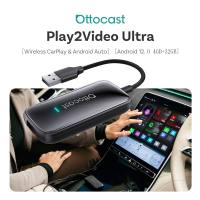
Ottocast Play2Video Ultra Ai Box Wireless CarPlay Android Auto Adapter Built in Youtube Netflix for Car with Wired Carplay
₱3,848.00₱4,864.00
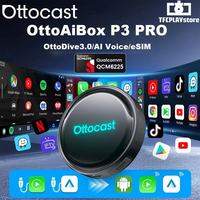
OTTOCAST P3 Pro CarPlay AI Box Android Adapter Wireless Android Auto 8GB RAM + 128GB Storage Cloud SIM Supports YouTube Netflix & TikTok Streaming
₱11,720.00₱14,988.00
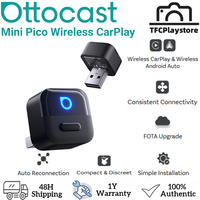
Ottocast Mini Pico Wireless CarPlay/Android Auto Adapter Plug & Play WiFi 6 Bluetooth 5.4 Fast Auto-Reconnect AI Assistant Support Connects for iPhone & Android
₱1,388.00₱1,671.00
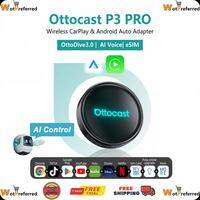
Ottocast P3 Pro CarPlay AI Box Android Adapter Wireless Android Auto Built-in AI Chat Assistant Powered by the Snapdragon 6225 with 8GB RAM and 128GB Storage
₱11,888.00₱14,850.00
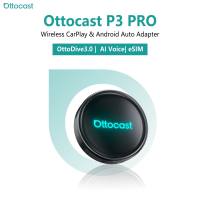
OTTOCAST P3 PRO AI Box Android 13 SM6225 8+128GB Wireless CarPlay Android Auto HDMI AI Voice Smart Android Box
₱11,700.00₱13,303.00
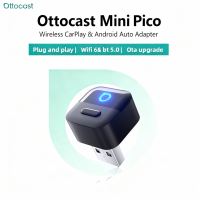
OTTOCAST Mini Pico 3.0 Cube 2 in 1 Wired To Wireless CarPlay Android Auto Adapter USB Stick Wifi Car Accessories
₱1,390.00₱2,128.00
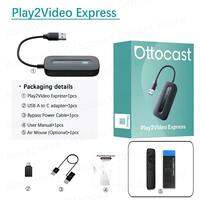
OTTOCAST | Ottocast Play2Video Express Ai Box Wireless CarPlay Android Auto Adapter Built in Youtube Netflix IPTV Video Box for 98% of Cars
₱3,602.11₱4,682.75
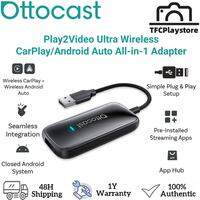
OTTOCAST Play2Video Ultra Wireless Apple CarPlay/Android Auto All-in-1 Adapter Plug and Play Built-in Netflix/YouTube
₱3,744.00₱4,749.00
About OTTOCAST
OTTOCAST is an automotive electronics and in-car connectivity brand that specialises in devices linking smartphones and digital entertainment services with vehicle infotainment systems. Its product portfolio centres on wireless Apple CarPlay and Android Auto adapters, AI Boxes, in-car entertainment systems, smart screens, and related automotive accessories. The company positions itself around upgrading existing vehicle infotainment systems without requiring major modifications to the vehicle.1
According to OTTOCAST’s official company history, the business traces its origins to 2009 when it began as Cartizan in Hong Kong, initially working on decoder products associated with CarPlay integration. The company states that it subsequently developed wireless smartphone-to-vehicle connectivity technology and launched its first universal smart adapter in 2017. The OTTOCAST brand later expanded into AI-powered in-car systems and wireless connectivity products.1
Today, OTTOCAST describes itself as a global automotive-electronics brand serving drivers in multiple markets. Its products are particularly associated with the aftermarket wireless CarPlay and Android Auto adapter category, although the company has expanded beyond simple adapters into Android-based AI Boxes and larger infotainment solutions.1
Company profile
| Field | Information |
|---|---|
| Brand name | OTTOCAST |
| Industry | Automotive electronics / in-car technology |
| Established | 2009, according to OTTOCAST |
| Early identity | Cartizan, Hong Kong |
| Specialization | Vehicle connectivity and infotainment |
| Core technologies | Apple CarPlay, Android Auto, wireless connectivity, Android-based in-car systems |
| Major products | Wireless adapters, AI Boxes, smart screens, in-car entertainment devices |
| Key market | Aftermarket automotive technology |
| Geographic reach | International / worldwide |
| Official website | ottocast.com |
History
2009–2015: Origins
OTTOCAST states that its history began in 2009 when the business operated as Cartizan in Hong Kong. During this early period, its focus was automotive electronics and decoder technology, including products designed around CarPlay integration.1
This early focus is significant for understanding OTTOCAST’s later product strategy: rather than manufacturing cars or replacing entire factory infotainment systems, the company concentrated on creating bridges between existing vehicle hardware and newer digital technologies.
2016: Wireless connectivity development
According to the company’s timeline, 2016 marked the launch of a project focused on wireless communication between smartphones using CarPlay or Android Auto and vehicle infotainment systems.1
The objective was to eliminate the need for users to physically connect their phones to the vehicle every time they wished to use smartphone-based infotainment.
2017: Universal smart adapter
In 2017, OTTOCAST states it launched its first universal CarPlay smart adapter. This represented a transition towards the type of aftermarket connectivity products for which the brand would subsequently become known.1
2019: Wireless CarPlay and Android Auto
OTTOCAST identifies 2019 as a major turning point. The company states it introduced wireless CarPlay and Android Auto adapters that allowed compatible vehicles to use these systems without a conventional wired connection.1
This positioned OTTOCAST in the growing market for wireless infotainment upgrades, particularly for drivers whose vehicles already supported wired CarPlay or Android Auto but did not offer wireless connectivity.
2020: AI Box and OttoDrive
In 2020, OTTOCAST states it launched its first AI Box under the OTTOCAST brand and introduced its first in-car system, Ottodrive.1
The AI Box concept went beyond simply converting wired CarPlay into wireless CarPlay. It brought an Android-based computing environment into compatible vehicles, allowing additional applications and entertainment functionality.
2021: Second-generation AI Box
In 2021, the company introduced a second-generation AI Box featuring HDMI output, expanding the potential entertainment and display capabilities of the platform.1
2022: U2-X and PICASOU2
OTTOCAST’s 2022 timeline includes the introduction of its first wireless CarPlay and Android Auto 2-in-1 adapter, the U2-X, alongside the third-generation PICASOU2 AI Box.1
The significance of this period was the convergence of Apple’s and Google’s automotive platforms into increasingly flexible aftermarket devices.
2023: Expansion of the product ecosystem
In 2023, OTTOCAST introduced OttoDrive 1.0 and expanded its product range with the OttoAIBox P3, Play2Video, A2Air Pro, U2Air Pro, and Ottoadapter MX, according to its published timeline.1
The company was therefore moving from being primarily an adapter manufacturer towards becoming a broader in-car technology ecosystem.
2024 onwards
OTTOCAST’s published timeline lists OttoDrive 2.0 in 2024 and identifies products including the OttoAIBox i3, designed for BMW applications, as well as the Car TV Mate and Nano-series AI Boxes.1
The company has also continued appearing at international technology and automotive trade events. Its current website lists appearances at events including CES 2026, CES 2025, IFA Berlin, IAAE Japan, Automechanika Frankfurt, and other international exhibitions.1
Products and technology
OTTOCAST’s products can broadly be divided into several categories.
Wireless CarPlay and Android Auto adapters
These are arguably the product category most closely associated with OTTOCAST.
The basic concept is straightforward: a compatible vehicle may already have wired CarPlay or Android Auto, but the driver must connect a phone using a USB cable. An OTTOCAST adapter sits between the vehicle and smartphone and provides a wireless connection.
The company currently offers multiple adapters designed for different combinations of CarPlay, Android Auto, and other connectivity technologies. For example, its Ottoadapter MX is marketed as a 3-in-1 solution supporting wireless CarPlay, Android Auto, and AirPlay under specified compatibility conditions.1
An important limitation is that these adapters generally do not add CarPlay to any vehicle indiscriminately. OTTOCAST’s own compatibility checker states that many of its adapters require the vehicle to already have factory wired CarPlay or Android Auto.1
AI Boxes
The AI Box is a more sophisticated product category.
Rather than simply acting as a wireless bridge between a smartphone and the car, an AI Box contains its own computing environment. Compatible units can provide an Android-based interface, applications, media functions, and additional connectivity features.
OTTOCAST’s current product lineup includes devices such as the OTTOAIBOX P3 Pro, which the company describes as an AI Box supporting wireless CarPlay, Android Auto, and AI voice-control functionality.1
The evolution from the original AI Box to later generations illustrates OTTOCAST’s broader strategy: turning the vehicle’s existing display into something closer to a connected smart-device platform.
Ottodrive
Ottodrive is OTTOCAST’s broader in-car software and system concept. The company describes its development through successive generations, including OttoDrive 1.0 and OttoDrive 2.0.1
The system is intended to integrate functions such as entertainment, voice commands, and connected applications into the vehicle environment.
Smart screens
OTTOCAST has also expanded into universal smart screens for vehicles that may lack modern factory infotainment capabilities. Its current website presents smart-screen solutions as an alternative for vehicles that do not have factory CarPlay.1
This is a different approach from its wireless adapters:
- Adapter: upgrades a compatible existing infotainment system.
- AI Box: adds additional computing and entertainment functionality to a compatible display.
- Smart screen: can provide an entirely new display and interface for vehicles without suitable factory infotainment.
How OTTOCAST works
The basic OTTOCAST proposition is based on aftermarket upgrading.
A typical compatible setup follows this signal path:
Smartphone → OTTOCAST device → vehicle infotainment system → car display
For a wireless CarPlay adapter, the device effectively removes the need for a physical USB connection between the smartphone and the vehicle.
For an AI Box, the architecture is more advanced:
Vehicle display → OTTOCAST AI Box → Android/apps/CarPlay/Android Auto
This allows a compatible vehicle to access functions beyond those originally provided by the factory infotainment system.
OTTOCAST emphasises a plug-and-play approach. Its current website describes installation as plugging the device into the vehicle’s USB port rather than dismantling the dashboard or making permanent modifications.1
Compatibility
Compatibility is one of the most important aspects of the OTTOCAST product ecosystem.
An OTTOCAST adapter is not universally compatible with every car. Compatibility depends on factors including:
- Vehicle make and model
- Model year
- Infotainment system
- Factory CarPlay/Android Auto implementation
- Whether the vehicle has wired or wireless CarPlay/Android Auto
- USB port configuration
- Phone operating system
- Specific OTTOCAST model
OTTOCAST provides a vehicle compatibility checker and recommends a physical self-test: connect an iPhone to the vehicle’s data USB port and check whether the CarPlay interface appears.1
This distinction is particularly important when describing the brand: OTTOCAST is primarily an aftermarket connectivity and infotainment-upgrade company, not a universal solution for adding CarPlay to every vehicle.
Brand positioning
OTTOCAST’s branding centres on the idea of making existing cars more technologically capable without replacing the entire vehicle.
Its current messaging describes the philosophy as “Smarter upgrades. Smoother drives.”1
The company’s stated brand concepts include:
- Innovation
- Connected simplicity
- Safety-driven exploration
- Boundless possibility1
In practical terms, the brand sits at the intersection of three markets: automotive aftermarket, consumer electronics, and connected-car technology.
That positioning differentiates OTTOCAST from traditional automotive accessory companies. Its products are less about physical vehicle customisation and more about software, connectivity, computing, and entertainment.
Global presence
OTTOCAST presents itself as an international brand rather than a company serving only one national automotive market. Its website lists participation in technology and automotive exhibitions across North America, Europe, and Asia, including CES, IFA, IAAE Japan, and Automechanika Frankfurt.1
The company also states that its products serve drivers worldwide and reports having been chosen by more than 300,000 drivers globally. This is a company-reported figure rather than an independently audited market-share statistic.1
Business model
OTTOCAST primarily operates in the consumer aftermarket automotive electronics sector.
Its products are sold directly to consumers through its online channels and through regional distribution and retail channels.
The business model can broadly be described as: develop automotive connectivity hardware, sell directly or through distributors, provide a software and firmware ecosystem with support, and expand into increasingly sophisticated in-car systems.
This is significant because the value of an OTTOCAST product is not limited to the physical adapter itself. Compatibility, firmware, software functionality, and ongoing support are all important parts of the user experience.
OTTOCAST vs traditional infotainment upgrades
One of OTTOCAST’s major selling points is that many of its solutions can upgrade a vehicle without replacing the factory head unit.
Traditional infotainment upgrades may involve:
- Replacing the head unit
- Removing dashboard components
- Installing new wiring
- Adding aftermarket displays
- Potentially losing some factory functions
OTTOCAST’s adapter-based approach is much simpler when the vehicle is already compatible:
Factory system + OTTOCAST device = upgraded connectivity
This makes the products particularly attractive to owners who prefer their existing factory display and controls but want modern wireless connectivity.
Advantages
The principal advantages of OTTOCAST’s product concept include:
- Wireless connectivity: Reduces dependence on USB cables for compatible systems.
- Plug-and-play installation: Many products can be installed without dismantling the vehicle.
- Aftermarket upgrade: Allows older vehicles with compatible factory systems to gain newer connectivity features.
- Multiple platforms: Products cover Apple CarPlay and Android Auto, with some models adding Android functionality and other technologies.
- AI Box ecosystem: Provides capabilities beyond a conventional wireless adapter.
- Broad vehicle coverage: OTTOCAST lists compatibility across a large number of vehicle brands and models for individual products.1
Limitations
There are also important limitations to consider.
Compatibility is not universal
A major misconception is that an OTTOCAST adapter can add CarPlay to any car. In reality, many adapters depend on an existing factory wired CarPlay or Android Auto implementation.1
Different products have different requirements
An adapter, AI Box, and smart screen do not have identical compatibility requirements. Consumers therefore need to check the specific product rather than assuming that compatibility with one OTTOCAST model means compatibility with all OTTOCAST products.
Performance depends on the vehicle
The quality of the final experience can depend on the car’s infotainment hardware, USB connection, smartphone, wireless environment, and software or firmware.
Entertainment features require responsible use
Features such as video streaming and gaming are primarily intended for passengers and stationary use. Drivers should follow local laws and avoid interacting with distracting content while driving.
Customer support and warranty
OTTOCAST currently advertises a one-year warranty on purchases, dedicated customer support through email, phone, and live chat, and a 30-day return policy, subject to the company’s terms.1
These policies are part of the company’s attempt to position itself as a consumer-electronics brand rather than simply an anonymous aftermarket hardware manufacturer.
Evolution of the brand
The most notable aspect of OTTOCAST’s development is the progression of its technology:
Automotive electronics → CarPlay decoding → wireless connectivity → wireless adapters → AI Boxes → integrated in-car computing → smart-screen/connected-car ecosystem
In other words, OTTOCAST’s business has evolved from solving a relatively narrow problem—connecting a smartphone to a car—towards a broader objective of turning the car into an extension of the user’s digital ecosystem.
The company’s own vision describes cars as extensions of people’s digital lives, covering activities such as working, travelling, and road trips while emphasising connectivity, entertainment, and safety.1
Timeline at a glance
| Year | Milestone |
|---|---|
| 2009 | Business begins as Cartizan in Hong Kong, according to OTTOCAST |
| 2016 | Wireless CarPlay/Android Auto smartphone-to-vehicle connectivity project |
| 2017 | First universal CarPlay smart adapter |
| 2019 | Wireless CarPlay/Android Auto adapters become a major focus |
| 2020 | First OTTOCAST AI Box and OttoDrive system |
| 2021 | Second-generation AI Box with HDMI output |
| 2022 | U2-X 2-in-1 wireless adapter and PICASOU2 |
| 2023 | OttoDrive 1.0, P3 and several new adapter/product lines |
| 2024 | OttoDrive 2.0, BMW-focused i3 and additional products |
| 2025–2026 | Continued international expansion and appearances at major technology/automotive exhibitions |
The timeline above is based on OTTOCAST’s published company history.1