Shop on Lazada
WangWang products
About WangWang
Overview
WangWang, also known by its Chinese name 旺旺 (Wàngwàng), is a food and beverage brand of Taiwanese origin. It is internationally recognised for its rice crackers, flavoured milk drinks, snack foods, and its distinctive “Hot-Kid” mascot. While the brand maintains a particularly strong presence in Taiwan and mainland China, it has expanded its product distribution to numerous overseas markets.
| Field | Information |
|---|---|
| Brand name | WangWang / Want-Want |
| Chinese name | 旺旺 |
| Pronunciation | Wàngwàng |
| Origin | Taiwan |
| Parent group | Want Want Holdings |
| Original company | I Lan Foods Industrial Co., Ltd. |
| Brand established | 1983 |
| Industry | Food and beverages |
| Best known for | Rice crackers, milk-flavoured drinks, snacks |
| Famous mascot | Hot-Kid (旺旺仔) |
| Major markets | Taiwan, mainland China, Southeast Asia, international markets |
| HK-listed subsidiary | Want Want China Holdings Ltd. (0151.HK) |
The parent organisation traces its roots to I Lan Foods, which was founded in Taiwan in 1962. The WangWang brand itself was introduced in 1983, initially focusing on the development and marketing of rice crackers.
History
1962–1970s: Pre-brand era
The corporate history began in 1962 with the establishment of I Lan Foods Industrial Co., Ltd. in Taiwan. The company originally specialised in canned agricultural products intended primarily for export.
During the 1970s, Tsai Eng-Meng assumed the role of general manager and redirected the company’s strategy. Rather than continuing solely as a canned-food manufacturer, the firm began exploring opportunities in the snack food sector.
1979: Creation of the Hot-Kid mascot
A defining element of the brand’s visual identity emerged in 1979 with the creation of the Hot-Kid mascot. This character became synonymous with WangWang products and evolved into one of the most recognisable food brand mascots across Chinese-speaking markets.
1983: Establishment of the WangWang brand
The pivotal moment for the brand occurred in 1983. I Lan Foods initiated a collaboration with Iwatsuka Confectionery Co., Ltd., a prominent Japanese rice cracker manufacturer, to develop the rice cracker market in Taiwan. The partnership produced items based on the Japanese senbei tradition.
In that same year, I Lan Foods officially commenced production and marketing under the WangWang (旺旺) name. The company’s determination to secure this partnership is now part of its corporate lore; according to official accounts, Tsai sent numerous unsuccessful letters to Iwatsuka before visiting the company in person to establish the relationship.
1989–1990s: Expansion into mainland China
Following its domestic success, WangWang expanded beyond Taiwan. Corporate records indicate that the WangWang brand entered the mainland Chinese market in 1989, leading to significant investment and factory development in the early 1990s. In 1992, the company established its first manufacturing base and sales office in Changsha, Hunan.
This expansion proved critical to the company’s long-term growth, as mainland China subsequently became its largest and most strategically important market.
1996: Singapore listing
Want Want Holdings was listed on the Singapore Exchange in 1996. Following a corporate restructuring, the company was delisted from the Singapore Exchange in 2007.
2008: Hong Kong listing
In 2008, Want Want China Holdings Limited was listed on the Main Board of the Hong Kong Stock Exchange under the stock code 0151. This listed entity serves as the primary corporate vehicle for the group’s food and beverage operations in China.
2020s: Diversified food group
WangWang has continued to broaden its product portfolio beyond its original rice crackers. The group now operates as a comprehensive food and beverage business with a footprint extending across multiple international markets. By 2024, the company reported a presence in 70 countries and regions.1
Brand name
The Chinese name 旺旺 is pronounced Wàngwàng. The character 旺 carries positive connotations of prosperity, flourishing, and thriving, rendering “旺旺” an auspicious brand name in Chinese culture.
The company’s official brand story offers an additional explanation for the nomenclature. According to this account, Tsai Eng-Meng sought a name that was memorable and associated the repeated sound with the act of eating rice crackers consecutively. He later encountered a dog at the Temple of the Eighteen Lords and linked its barking to the pronunciation of “旺” (wàng). Consequently, the name possesses both a commercially memorable phonetic quality and a cultural association with prosperity.
Products
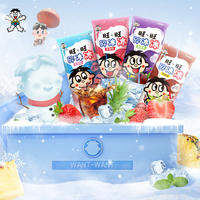
WangWang operates primarily as a snack and beverage company. Its product range has expanded significantly from its initial focus on rice crackers.
Rice crackers
Rice crackers, specifically those in the senbei style, remain the category most closely identified with the brand. WangWang’s early technical cooperation with Iwatsuka was instrumental in establishing its position within the Taiwanese rice cracker market.
Milk-flavoured drinks
Another signature category comprises WangWang’s milk-flavoured beverages. These products have achieved high recognition in mainland China and various other Asian markets.
Snack foods
The group manufactures a diverse array of snacks, including:
- Rice crackers
- Ball cakes
- Gummies
- Candies
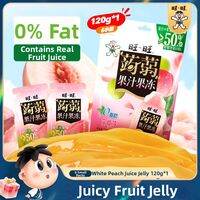
- Jellies
- Popsicles
- Nuts
- Other packaged snacks
Its broader brand portfolio includes names such as Hot-Kid, QQ Gummy, Mr. Bond, Aiyo, and Yappy.
The Hot-Kid mascot
The Hot-Kid mascot is arguably the most significant visual component of WangWang’s branding. Typically depicted as a smiling young boy with a distinctive hairstyle, the character features prominently on product packaging.
Although the mascot dates back to 1979—four years prior to the official establishment of the WangWang brand in 1983—its widespread use on packaging has made it nearly as recognisable as the brand name itself. In mainland China, the character is commonly referred to as 旺旺仔, or the “Want Want kid”.
Brand identity
WangWang’s identity is anchored by several recurring themes:
Prosperity
The semantic meaning of 旺 imbues the brand with a naturally auspicious association, evoking concepts of prosperity and flourishing.
Childhood and nostalgia
Through the Hot-Kid mascot, colourful packaging, and sweet snack and milk products, WangWang has cultivated a strong association with childhood memories in both Taiwan and mainland China. For many consumers who came of age in the 1990s and 2000s, these products are integral to their personal snack culture history.
Chinese-language cultural identity
Unlike international snack brands that often adapt Western branding for Asian markets, WangWang’s identity is deeply rooted in Chinese-language visual culture. This is expressed through the name 旺旺, the Hot-Kid character, red packaging, and traditional auspicious symbolism.
Playfulness
The repetitive “Want Want” sound and cartoon mascot are designed to be easily remembered and appealing to children.
Market position
WangWang holds particular significance in mainland China, where it has built an extensive manufacturing and distribution network. The company reports that its China operations comprise 53 sales branches, 419 sales offices, 34 production bases, and 76 factories. Distribution reaches throughout the country, including remote regions such as Inner Mongolia, Xinjiang, and Tibet.
Globally, the group states that its products reach markets across Asia, Africa, North America, Central and South America, Oceania, and Europe. This international footprint positions WangWang as a major pan-Asian food and beverage business rather than solely a Taiwanese snack brand.
Corporate structure
It is necessary to distinguish between WangWang as a consumer brand and Want Want as a corporate group.
The consumer brand is WangWang / 旺旺, while the overarching corporate entity is Want Want Holdings. The principal listed subsidiary for the food business is:
Want Want China Holdings Limited (中國旺旺控股有限公司)
Hong Kong Stock Exchange: 0151.HK
Listed in 2008, this company oversees major food and beverage operations, with a specific focus on the Chinese market.
Beyond food
The wider Want Want Group has diversified beyond its core food and beverage operations. Interests now include media, insurance, healthcare, hotels, elderly care, and cultural businesses. As a result, the name WangWang may refer either to the familiar snack brand or to the larger conglomerate.
International presence
Although WangWang originated in Taiwan and achieved dominance in China, it has progressively internationalised. Its stated overseas footprint encompasses:
- East and Southeast Asia
- Africa
- North America
- Central and South America
- Oceania
- Europe
The group currently describes its international reach as covering 70 countries and regions.1 In the Philippines and other international locations, WangWang products are frequently available in Asian supermarkets and Chinese grocery stores, where staples such as rice crackers, milk drinks, and gummies are sold.
Corporate philosophy
WangWang identifies three core concepts in its management philosophy:
People-oriented — Self-confidence — Unity
The company cites these principles as foundational to its effort to build a broad enterprise and pursue its ambition of becoming a “comprehensive food and beverage kingdom.”
Major timeline
| Year | Event |
|---|---|
| 1962 | I Lan Foods Industrial Co., Ltd. established in Taiwan |
| 1977 | Tsai Eng-Meng appointed general manager |
| 1979 | Hot-Kid mascot created |
| 1983 | WangWang brand officially established; cooperation with Iwatsuka begins |
| 1989 | WangWang brand enters mainland China |
| 1992 | First mainland Chinese factory/sales base established in Hunan |
| 1996 | Want Want Holdings listed in Singapore |
| 2007 | Singapore listing delisted following restructuring |
| 2008 | Want Want China Holdings listed on Hong Kong Stock Exchange |
| 2009 | Want Want China TDR listed in Taiwan |
| 2013 | WangWang products and company flag carried aboard China’s Shenzhou-10 spacecraft |
| 2022 | Group celebrates 60th anniversary; mainland China factory operations reach 30 years |
| 2023 | Group wins China Grand Awards for Industry |
| 2024 | Group receives its first Zero Carbon Factory Certificate |
Brand recognition
WangWang’s market success extends beyond product sales to encompass exceptional brand recognition. The combination of the 旺旺 name, red packaging, Hot-Kid mascot, rice crackers, and milk drinks has created a highly distinctive visual identity.
Unlike many food brands that alter packaging substantially between product lines, WangWang has historically maintained consistent brand elements across its portfolio. This consistency allows consumers to identify WangWang products visually from a distance, often before reading specific product names.
Cultural significance
In Taiwan, WangWang is an established domestic brand with heritage dating to the 1980s. In mainland China, it became closely associated with the rapid expansion of packaged snacks and beverages during the economic transformation of the 1990s and 2000s.
This history has generated a significant nostalgia factor, with products frequently recalled as childhood staples by those who grew up during that era. Furthermore, the brand stands as a notable example of a Taiwanese company successfully building a massive consumer food business in mainland China.
Controversies and public image
When discussing controversies, it is important to differentiate between the Want Want corporate group and the snack brand itself.
The group expanded into media through the acquisition of China Times Group and related assets. Due to this media ownership and the public positions of its chairman, the wider Want Want Group has been subject to political debate and criticism in Taiwan. These issues pertain to the corporate group’s media activities rather than the composition or history of consumer products such as WangWang rice crackers.